



There's a lot of discourse about the ethics of the ultra-rich (fair), with criticism often accompanied by aghast decrees: "I couldn't spend all that money even if I tried!"
But here's the thing: I genuinely in my heart of hearts believe I could.
I LOVE spending money. It's one of my favorite things to do.
I love buying clothes. I love buying shoes. I love buying presents and trips and books and little treats and dinners and cocktails and donations and all of it. I have a 13-part action plan in place for the day I win the lottery. I am not a natural saver — there are simply too many fun things to buy or do. And lest us not pretend that money isn’t an intensely emotional, intensely personal thing on top of all of that, too!

I also in almost equal parts adore self ~improvement~ and *actualization* and #notworkinguntiliam100, which led me to, in my adulthood, try to get recklessly honest and responsible regarding my financial personality.
Over the years, I have developed the following practices to deal with my financial proclivities, and my entire relationship with money falls into one of three buckets: how I save, how I spend, and how we share it as a couple.
A disclaimer before we begin: I am not a financial planner. I have never once deprived myself of anything. If you have specific questions — especially about investments, which always carries risk and where returns can be volatile — please talk to an actual financial advisor.
Saving!
Automate it before you see it. The first person who gets paid is your future self! Beyond our 401(k)s and HSAs, we route a set amount from every paycheck automatically into savings and investments — money we never factor into our usable income. It's for future-vacation self, future-forever-home self, future-sending-kids-to-college self. When you don't see it, you don't touch it. If it's sitting in checking, I will try to spend it!
Max out your 401(k) — at minimum, get the full match. Compounding rewards small changes made early, and it’s especially sweet pre-tax. Here's the math on a retirement account’s 6% conservative return if you max out the full $24,500 annual contribution limit:
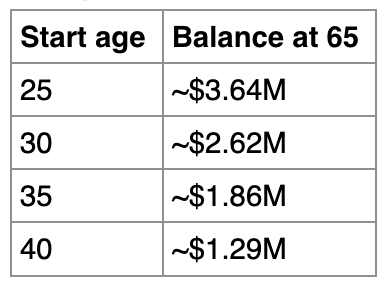
and that's before your employer's match contribution, which you AT MINIMUM need to maximize! Every five-year delay costs roughly $700K–$1M by 65 — the gap between starting at 25 versus 30 alone is nearly $1M, almost predicated entirely on lost compounding time, not lost contributions from your bank account.

my retirement plans

Pretend bonuses don't exist. We both earn a non-trivial amount of our income through bonuses, equity, and profit-sharing, but we never budget for it in our financial planning and never account for it in our day-to-day spending. When it lands, it's a lovely way to fund a vacation or hit a savings goal early — never something to rely on!
Build an emergency fund, full stop. If you take one thing from this list, let it be the 401(k) match. The second thing is this: our entire relationship to money changed overnight after Carter's cancer diagnosis in 2023 — we went from a two-income household with no major expenses beyond rent to one income hemorrhaging money on not only medical bills but the associated expenses that come with a loved one being sick (don't even get me started on $40-a-night hospital parking). Conservative advice is three months of expenses in an easily accessible high-yield savings account. Given our risk tolerance, we prefer closer to six.

The Lauren Letter will always be free. But if this space has become something you look forward to—a small ritual in your week, a source of inspiration, a reminder to approach life with more intention—you now have the option to support it.
Spending!
Make your default a debit card, not a credit card. Controversial and unpopular, I know! Maxing out points is extremely tempting. For context, Carter and I do have two credit cards (an American Express Platinum and an American Express Delta SkyMiles® Platinum, chosen deliberately and maximized to the extreme (a post for another day). But, for a natural born spender (positive!), credit cards can quickly become dangerous (scary!). So, daily expenses go on debit: money in, money out, essentially cash with the convenience of a card. Credit cards are reserved for large purchases we want covered by dispute protection, travel, or specific benefit categories — and the rule is you pay it off immediately. No balance sits, not even until the statement!

Log every single dollar. I keep a manual budget. It genuinely doesn’t change anything about our bills or savings, since all of that runs on autopilot — it’s entirely about the discomfort of tracking. A $50-minimum Uber Eats order for two people, once you factor in fees and tips, feels a lot less appealing when you have to type it into a spreadsheet four times over with a little shame on Monday morning. It keeps us honest, and the tracker I use also breaks down the percentage of spending going into each category (groceries, streaming subscriptions, etc.), which is its own reality check.

Stop buying random shit on Amazon. When I left Big Law for a more specialized firm with better work-life balance, I took nearly a 50% pay cut. But the biggest lifestyle adjustment wasn't where we lived or traveled — it was cutting the mindless, miscellaneous spending on things I didn't need. Amazon is the main offender, but this applies to any category. Wait 24 hours. Better yet, wait a week. If you still want it by then, it’s aligned with your values; not just an impulsive attempt at a dopamine hit.
Pro tip! Keep a private running wish-list on myregistry.com. It helps me “put a pin” in coveted pieces until I have fulfilled my self-imposed waiting period. This also comes in handy when people ask what you want for birthdays/holidays!
Think about this meme constantly.

The first time I saw this image I pulled out my calculator because I truly could not fathom this as reality. It ruined my day to discover it is true. Think critically about your $27.40 — it adds up fast.
Stop treating sales as permission slips. It's easy to get swept up in the dopamine of a good discount, especially one dressed up with urgency. But I've learned I'm often more excited by the price than the piece itself — and that's how you end up with a closet or home full of things you don't actually love. Go in with a list. I know the Tuckernuck silhouettes I want before the Sample Sale starts. I know what I'm hunting for at an estate sale — an etched hurricane lamp, silver frames, Wedgwood — before I walk in. Urgency is not your friend!
Get off the hot girl hamster wheel. There's a great episode of The Money with Katie Show on this — Katie Gatti Tassin's whole thesis is that women are conditioned to believe spending thousands of dollars a year on upkeep isn't just normal, it's required. Inspired by her reporting, I have experimented opting out of pieces of it. I went darker with my hair color specifically so I can stretch the time between salon appointments. I cycle through manicure-and-pedicure phases — the second it starts feeling like a task instead of a treat, I take at least a two-month hiatus. And, to be clear, I will never give up Botox or splurge-worthy skincare — this isn't about deprivation or becoming ugly (only half kidding)! It's about two things: being mindful, and refusing to accept that something is "normal" just because everyone else is doing it.


Spend on experiences over things. I regret material purchases about half the time and wind up in the purgatory of returns. I almost never regret an experience, especially one shared with Carter or the people I love. That said, I’d rather take fewer, more luxurious trips a year over travel every month, which may require staying in an Airbnb and cooking meals in the rental kitchen. Mileage may vary for you (literally)! What matters is to know your values and spend in line with them!
Practice a little malicious compliance with medical bills. Pay them, and pay them on time — but take the payment plan if there's no interest accruing (not to be confused with medical financing that may have a 0% interest introductory period). It's the one thing we don't pay off immediately. Mostly because, after everything we've seen, it feels like a small act of financial resistance that costs us nothing!!! Hospitals and providers will work with you, and sometimes even offer discounts, so don’t be afraid to call and ask!

Sharing!
Combine your finances (almost entirely* — see below). One of the best pieces of advice I ever received about money and partnership: think in terms of household income, not individual buckets. Our contributions as the higher earner have waxed and waned over the years, as have our responsibilities at home — combining income recognizes what we each bring to the family, regardless of whose name is on the paycheck.

Make sure you both actually have access. Trust is part of it; practicality is the other part. When Carter had cancer, we discovered one of our "joint" savings accounts didn't actually include me — and the only way to fix it required an in-person branch visit during business hours, which is nearly impossible when your husband is immunocompromised and every spare hour is spent working to keep the household afloat. Access matters. Check it before you need it.
*Keep some "funny money." Carter and I each get a set amount of independent cash every month, agreed upon together, to spend on whatever we want outside of shared expenses: dinners with friends, shopping, gifts, personal savings. There's something genuinely important about having independence within a partnership — the freedom to spend $300 on skincare, or an eye-watering amount on Pokémon cards, without a side-eye from your spouse. Pick a number generous enough for real autonomy, but below the threshold where a purchase should become a family conversation. We both technically have access to each other's funny money for emergencies, but we don't check it.

Talk about money as "we." Every conversation about money should run through "we" — "we" did great saving this month, "we" were over budget on champagne, etc. It's a small shift, and most of the time it’s truly just semantics, but it reframes money as a shared project instead of a scoreboard. You're a team. Speak like one.
P.S. I promise to always keep The Lauren Letter free as my little exercise of trying to make the world a bit more beautiful. If, in return, you could considering giving this post a “like” or share with a friend, it would just mean the world to me.

I really enjoy learning from other people how they also manage their money! It’s something that’s not always easy to talk about but talking about it is really helpful as we can all learn from one another!! Paying myself first is one of the most helpful mindset shifts I’ve had in recent years. So glad you wrote this piece!